When Reading Stock Quotes, the Term "52-wk Range" Implies the Following
At first glance, stock charts appear to be a cluttered show of lines, colors, numbers and acronyms. One time you break them downward into individual parts, withal, reading them becomes a much more manageable task.
To be sure, knowing how to perform in-depth stock analysis isn't a requisite for starting to invest (learn how to invest in stocks ; no technical analysis required). Merely understanding the basics of stock charts can help y'all make investment decisions more confidently.
Stock chart components
One of the almost convenient means to larn well-nigh stock charts is through Google Finance. Just search a company's ticker, and you'll see a uncomplicated chart that'south the equivalent of the shallow end of the pool during a swim lesson. (Don't know the company'south ticker symbol? You can search online for that.)
As an example, let'due south look at Apple tree (AAPL) , currently the largest stock by weight in the S&P 500 .
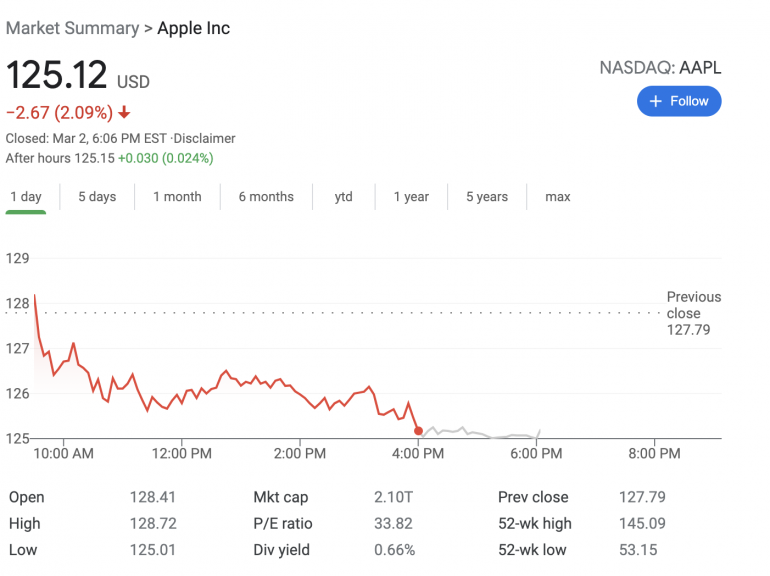
This chart shows the stock toll was $125.12 at the market close on March two. Closing price refers to the last toll a stock traded for during regular marketplace hours — 9:30 a.grand. to 4 p.g. Eastern Fourth dimension. During regular trading hours, the cost volition probable fluctuate. The "after hours" price is $125.15, reflecting the price the stock was currently being traded for outside of regular hours. (Larn more about later-hours trading , and why information technology's not the best thought for beginners.)
We can also see the stock price "closed" $2.67 lower than it did on the previous trading solar day (when the close price was $127.79), meaning the cost brutal by 2.09%. The red line shows the various price changes throughout the day, but choosing any of the other time periods would show the diverse price changes throughout that menstruation.
That line, cogent cost increases and decreases over a specified period of fourth dimension, makes up the backbone of nearly stock charts. The y-centrality (vertical axis) shows prices in dollars, while the x-centrality (horizontal axis) shows how much fourth dimension has passed in the chosen period. In this chart, the gray line shows how the stock is performing during afterwards-hours trading.
» Start analyzing: Cheque out our listing of the best online brokers for stock trading , and dig into each broker's review for a detailed look at their enquiry and data offering.
Basic stock chart terms to know
-
Open, high, depression and previous close. The open is the showtime cost at which a stock trades during regular market hours, while high and low reverberate the highest and lowest prices the stock reaches during those hours, respectively. Previous close is the closing price of the previous trading day.
-
Market cap. Shown hither as "Mkt cap," market cap ways marketplace capitalization, which measures the size of a visitor based on the number of its shares on the stock marketplace multiplied by its electric current share price. In Apple's example, your eyes exercise not deceive you: That'due south a market cap of $two.1 trillion — one of the largest in the world. (Learn more virtually market capitalization .)
-
PE ratio. This stands for price-to-earnings ratio, which some investors may use to decide if a stock is undervalued, overvalued or adequately valued. (Go the details on PE ratio .)
-
Dividend yield. Shown here every bit "Div yield," dividend yield tells you how much an investor may receive annually in dividends (cash payments companies may offer to shareholders), expressed equally a per centum of the current share price. Apple tree's quarterly dividend for the past four quarters was $0.2050 per share. Multiply that by four (for a full-year dividend) and you get $0.82, which is 0.66% of its current share price of $125.12. (Learn more nigh dividends .)
-
52-wk high and low. 52-week loftier is the highest price the stock has traded for during the preceding 52 weeks, while the 52-week depression is (you guessed it) the lowest price the stock has traded for during the preceding 52 weeks.
More advanced stock nautical chart terms
Google's charts are pretty bare-basic, making them a swell identify to larn. But in one case you get-go studying more advanced charts, you lot'll run across a few more than terms worth knowing.
Bid and ask
The bid is the highest price an investor is willing to pay for a stock. If you see, for example, $124.61 as the bid, investors are currently willing to buy the stock at a toll of $124.61 per share. The ask, on the other hand, is the lowest toll an investor is willing to sell a stock for. If you come across an enquire of $124.65, sellers are currently selling for $124.65 per share.
Note in that location'south a $0.04 deviation between the two — this is called the bid-ask spread. More often than not, when there'south loftier trading activity with lots of willing buyers and sellers, spreads will exist smaller. With less trading activity (such as during later on-hours trading or trading in less popular stocks), bid-ask spreads may be wider. And when spreads are wider, information technology may exist more difficult for an investor's merchandise to be executed, or for the trade to get through at the price they wanted.
Volume, average volume and day'due south range
Volume represents the number of shares that have been traded so far that solar day, while average volume is the average daily volume for a specified period. Solar day's range shows the highest and lowest prices the stock has traded for upward to the electric current moment of that trading solar day.
Beta
Beta shows how volatile a stock'southward price is compared with the stock market, which may exist an indicator of how risky the stock is. If beta is greater than one, the stock has historically been more than volatile than the stock marketplace (typically represented by either the Due south&P 500 or a total stock marketplace alphabetize) for the specified period. If beta is less than one but greater than zero, information technology's been less volatile than the overall market for that period. As always, though, by performance isn't indicative of future operation.
EPS (TTM) and earnings date
EPS (TTM) stands for earnings per share for the last 12 months (or, technically, "trailing 12 months"), and that number is the "E" in PE ratio. You can get this number by dividing the nigh recently reported company earnings by the number of the company'southward shares available on the stock market. The earnings engagement is the publicly displayed window of time for when the company will announce its latest quarterly earnings.
Ex-dividend appointment
In order to receive the company'due south dividend for the next menstruation, you'll have to become a shareholder (that is, buy its stock) before the ex-dividend date. If you lot buy the stock on or after the ex-dividend date, yous won't get the dividend for that period. As far as dividends become, procrastination doesn't pay.
1-year target estimate
This is an estimate of what the stock's price could be in one twelvemonth. This reading often represents a consensus of many analysts' i-twelvemonth price targets, but be aware that while analysts use complicated calculations to arrive at their estimates, it's still just a forecast. And as anyone who's been annoyed with their local meteorologist knows, forecasts tin can be incorrect.
As you continue learning almost stock charts, keep a few points in mind:
-
Information technology's rare for a stock to move in one direction. Swings are normal.
-
What appears to be a big spike or slump may not exist. Expect at the y-centrality; prices may range from a few cents' divergence to a few dollars, depending on the stock.
-
Even if a stock price is ascent in the curt term, that increase may be a blip among a prolonged decline. Expect at longer time horizons (one, iii and five years) for a more consummate movie of trading activeness.
-
Not all charts will be right for your fourth dimension horizon. Poring over an intraday price chart, which looks at one day's fluctuations, won't make sense for someone who plans to be invested for 20 years. A day trader, however, may find it helpful.
Disclosure: The author held no positions in the aforementioned investments at the original time of publication.
Source: https://www.nerdwallet.com/article/investing/how-to-interpret-stock-charts-and-data
0 Response to "When Reading Stock Quotes, the Term "52-wk Range" Implies the Following"
Post a Comment